

In a world where your toaster might just be smarter than you, IoT development boards are the unsung heroes behind the curtain. These nifty little gadgets are the perfect playground for tech enthusiasts and seasoned developers alike, turning ambitious ideas into reality faster than you can say “smart fridge.”
Overview of IoT Development Boards
IoT development boards serve as foundational tools in building innovative smart technologies. Their versatility appeals to both tech enthusiasts and professional developers.
Definition and Purpose
IoT development boards are hardware platforms designed to facilitate the design and prototyping of IoT applications. These boards often include microcontrollers, sensors, and connectivity options. They enable developers to test ideas quickly, making it easier to create functional prototypes. With various interfaces available, developers can connect multiple devices for data collection and processing. Purposefully built for experimentation, they simplify the integration of hardware and software.
Importance in IoT Ecosystem
In the IoT ecosystem, development boards play a pivotal role in connecting devices and enabling communication. These tools support rapid prototyping, expediting the innovation process. By allowing developers to explore different connectivity options, they foster collaboration between hardware and software. Furthermore, the availability of numerous online resources and community support enhances learning and development. As a result, they significantly contribute to the growth of smart technology solutions.
Popular IoT Development Boards
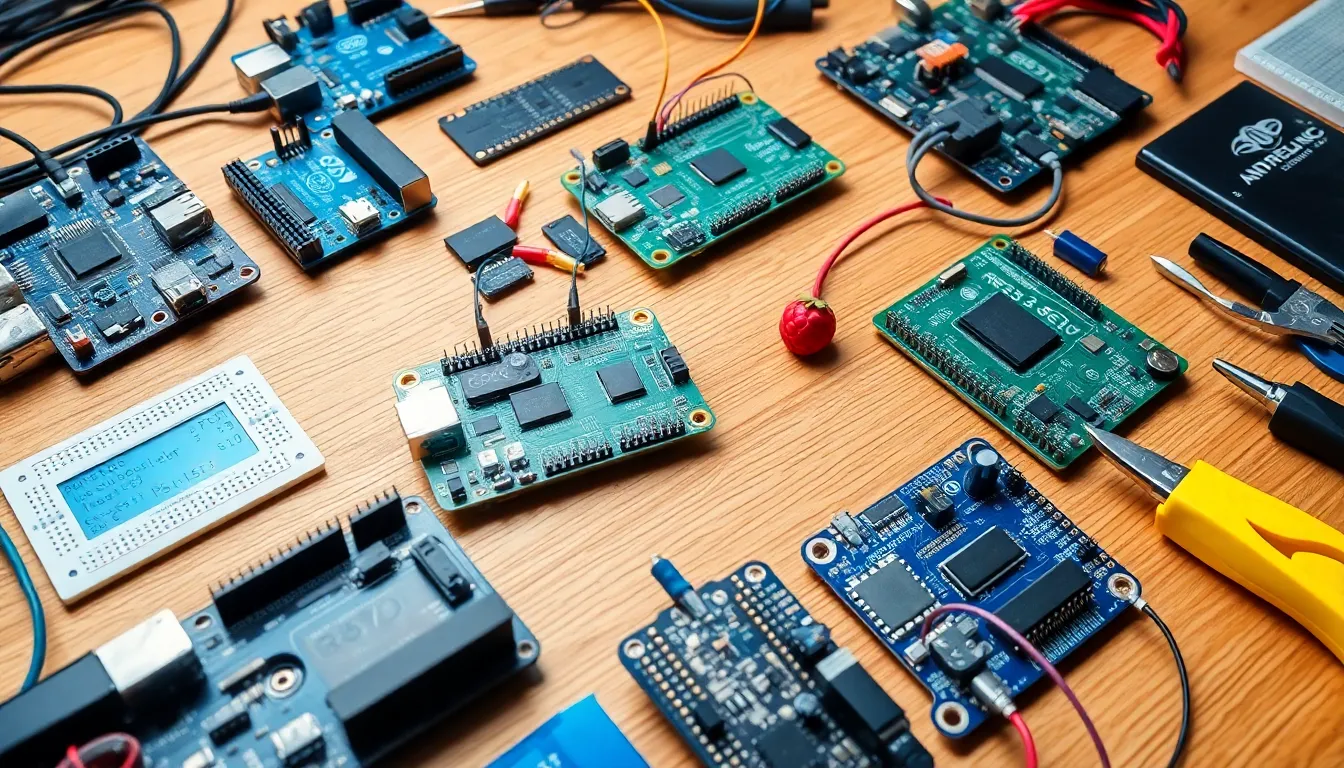
Numerous IoT development boards cater to diverse needs in the technology landscape. Each offers unique features for various projects, appealing to both beginners and seasoned developers.
Arduino
Arduino boards are known for their simplicity and versatility. They feature an open-source platform that supports a wide range of sensors and actuators. Users can program in C++ and access numerous libraries for functionality. Various models, such as Arduino Uno and Arduino Nano, provide options for different project requirements. Community forums and extensive documentation make troubleshooting accessible, enhancing the learning curve.
Raspberry Pi
Raspberry Pi units serve as compact computers designed for embedded projects. They support full operating systems, such as Linux, enabling advanced programming capabilities. Users can integrate various components, including cameras and displays, through GPIO pins. The Raspberry Pi Zero, Raspberry Pi 3, and Raspberry Pi 4 cater to varying processing power and memory needs. Online resources foster collaboration, making it easier to share ideas and innovations.
ESP8266/ESP32
ESP8266 and ESP32 boards excel in Wi-Fi and Bluetooth connectivity. These chips enable wireless communication for IoT applications. They allow developers to write in MicroPython or C++, providing flexibility for coding preferences. The ESP32 offers added features, such as dual-core processing and multiple I/O ports, compared to the ESP8266. Each option serves as a cost-effective solution for building connected devices, minimizing the barrier to entry for new projects.
Key Features to Consider
Understanding key features in IoT development boards equips developers to make informed choices. Features like processing power, connectivity options, and power consumption significantly impact project outcomes.
Processing Power
Processing power dictates a board’s capability in handling tasks. Microcontrollers with higher clock speeds enhance performance for complex applications. A board featuring multiple cores boosts processing capabilities, supporting advanced algorithms and data processing. For instance, the Raspberry Pi offers robust processing power, facilitating seamless execution of demanding tasks. Effective processing power enables real-time data analysis, essential for smart device applications.
Connectivity Options
Connectivity options influence how devices interact with networks and other systems. Most IoT development boards support various communication protocols like Wi-Fi, Bluetooth, and Zigbee. A versatile board enhances functionality by adapting to different project requirements. The ESP32 exemplifies excellent wireless connectivity, integrating both Wi-Fi and Bluetooth, thereby catering to diverse IoT needs. Prioritizing connectivity options ensures seamless integration in an interconnected ecosystem.
Power Consumption
Power consumption directly affects the longevity of devices. Boards designed for low power usage extend battery life, crucial for mobile and remote applications. An efficient board operates effectively while consuming minimal energy. For example, the Arduino offers optimized energy usage, making it suitable for battery-operated projects. Developers must evaluate power consumption to balance performance and efficiency, impacting overall project sustainability.
Applications of IoT Development Boards
IoT development boards find numerous applications across various sectors, enhancing functionality and user experience in innovative ways.
Home Automation
Home automation utilizes IoT development boards to create smart environments. Devices such as smart lights, thermostats, and security systems enhance convenience and energy efficiency. Arduino boards often power simple automation tasks, allowing users to control multiple appliances through a single interface. Raspberry Pi units enable more complex systems, integrating voice recognition and advanced control mechanisms. Connectivity features ensure devices communicate effectively, providing real-time monitoring and control from smartphones or voice assistants.
Industrial IoT
Industrial IoT applications thrive with the help of development boards. Boards like the ESP32 facilitate real-time monitoring of machinery and equipment, which prevents downtime and improves efficiency. Sensors collect data on temperature, vibrations, or pressure, sending alerts for maintenance needs. By utilizing these boards, companies streamline operations, reduce costs, and enhance safety within their facilities. Data analytics performed on Raspberry Pi units allows industries to interpret trends and make informed decisions, leading to improved productivity.
Wearable Devices
Wearable devices rely on IoT development boards to track health metrics and enhance user interaction. Compact boards like the ESP8266 offer low power consumption for fitness trackers and smartwatches, helping to extend battery life. These devices monitor heart rates, sleep patterns, and physical activities, providing valuable insights to users. Integration of sensors with development boards allows for real-time data transmission to smartphones for easy access. Such advancements improve health management and foster user engagement, making IoT development boards pivotal in the wearables sector.
Conclusion
IoT development boards are game changers in the tech landscape. They empower developers and hobbyists alike to create innovative solutions that enhance everyday life. With a variety of options available each tailored to specific needs these boards facilitate rapid prototyping and seamless connectivity.
As technology continues to evolve the significance of these platforms will only grow. Their role in diverse applications from home automation to industrial monitoring demonstrates their versatility. By harnessing the potential of IoT development boards anyone can contribute to the smart technology revolution.


